


By Allan Stein
|
May 10, 2026Updated:May 10, 2026
TUCSON, Ariz.—They are the dinosaurs of the modern age—hulking retired aircraft baking in the Arizona sun, stretching in rows across the desert.
Once America’s defenders of the sky—B-52 Stratofortress and B-1B Lancer bombers, F-16 Fighting Falcon fighters, C-130 Hercules and C-5 Galaxy cargo planes—they now sit idle, preserved for parts or history.
Maintaining and reclaiming these aircraft is no small task at the nation’s only military aircraft “boneyard.”
At Davis–Monthan Air Force Base, the 309th Aerospace Maintenance and Regeneration Group (AMARG) oversees that work.
“Most of these planes have been decommissioned, but the parts are still very useful. The parts are all viable,” public relations manager Robert Raine said during an April 21 tour of the 2,600-acre (4-square-mile) AMARG facility in Tucson.
Each aircraft is secured for long-term storage, drained of fluids, stripped of explosive components, and preserved against the slow wear of the desert.
Depending on the aircraft, some could be brought back into service, Raine said.
Since 1964, the maintenance group has served as the sole designated storage, salvage, and disposal center for U.S. military and government organization aircraft.
The facility employs more than 700 workers and encompasses more than half a million square feet of industrial space.
Here, aircraft come to die, hibernate, or be reborn, their components cleaned, repaired, and repurposed for use in other machines—for conflicts now and those yet to come.
The facility opened shortly after World War II, on April 1, 1946. The site was chosen for its dry desert climate and its ability to store vast quantities of surplus aircraft and military equipment.
Hard caliche soil, along with the absence of earthquakes and extreme weather such as tornadoes and hurricanes, made it an ideal place for long-term storage.
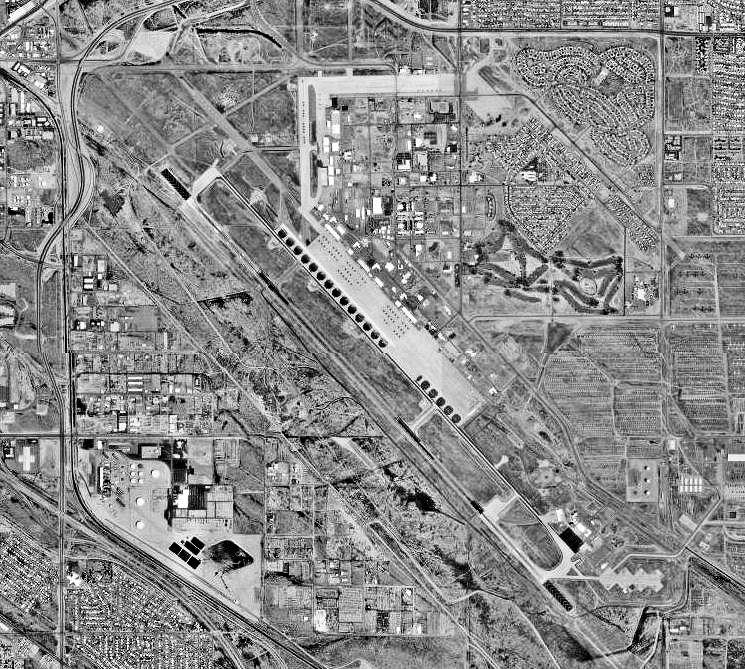
USGS orthophoto of Davis-Monthan Air Force Base in Tucson, Ariz., on May 16, 1992. United States Geological Survey/Public Domain, CC0
The sprawling boneyard is home to 3,488 aircraft, ranging from supersonic fighter jets to massive refueling and cargo planes to strategic bombers—75 aircraft types and 6,700 engines in all.
“AMARG is the last stop for parts” for legacy aircraft, Raine told The Epoch Times. However, it is “not an infinite source.”
When a component is needed, the request typically begins in the global supply system, he said.
If it is not available there, the request moves up the chain to Air Force weapon system program offices, Navy and Marine Corps program management authorities, or Navy Supply Weapon Systems Support.
During storage, the planes are inventoried, flushed of fluids, washed, sealed tight with tape and a special spray material, and placed in storage for years or decades.
Source: